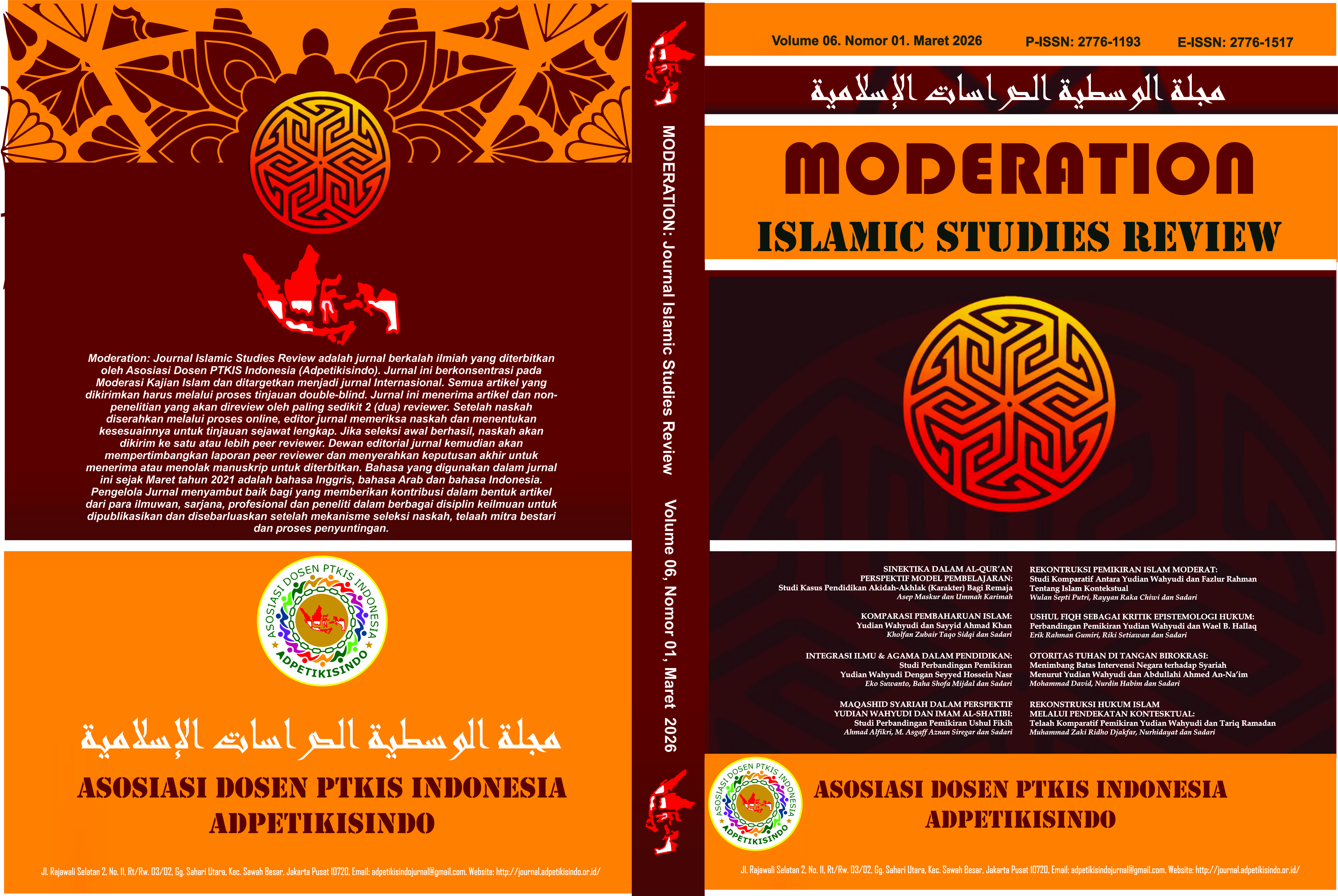
USHUL FIQH SEBAGAI KRITIK EPISTEMOLOGI HUKUM: Perbandingan Pemikiran Yudian Wahyudi dan Wael B. Hallaq
DOI:
https://doi.org/10.63195/moderation.v6i1.175Keywords:
Usul Fiqh; Critique of Legal Epistemology; Comparative Thought; Yudian Wahyudi; Wael B. HallaqAbstract
The epistemological debate between Hallaq and Yudian has important implications for the development of ushul fiqh
and Islamic law in Indonesia. Theoretically, this comparison confirms that ushul fiqh can no longer be understood solely as the science
of deriving law from normative texts, but rather as a discipline of legal epistemology. Ushul fiqh serves to assess the basic assumptions,
rationality, and ethical orientation of a legal system. In the Indonesian context, this epistemological function is particularly relevant
given that national law is built on a synthesis of customary law, Western law, and religious values. Ushul fiqh, within this
framework, can serve as a tool for critical reflection on the normative foundations of national law without necessarily claiming formal
supremacy over the state legal system. Hallaq's approach provides an important theoretical warning regarding the dangers of reducing
Islamic law to an instrument of the state. The implication of this critique is the need to safeguard the epistemological autonomy of
Islamic law from the logic of positivism and state sovereignty. In Indonesia, this warning is relevant in the context of legislation that
claims to be based on sharia but lacks the moral dimension and substantive justice. Usul fiqh, therefore, must function as a moral
guardian, not merely a symbolic legitimation of state legal products. However, if Hallaq's implications are applied literally, it has the
potential to foster an exclusive and apolitical attitude that is less productive in the Indonesian context. Therefore, Yudian's approach
offers more practical implications. Progressive ushul fiqh encourages the active involvement of Muslim scholars in the legislative,
judicial, and public policy-making processes. Islamic law is not positioned as a parallel legal system, but rather as a source of public
ethics that contributes to the formation of just and contextual national law. In practice, this implication is clearly evident in the
development of Islamic family law, religious fatwas, and religious courts. Progressive ushul fiqh allows for a critical assessment of
positive legal norms using the principles of justice, welfare, and protection of vulnerable groups. This approach aligns with the practice
of Islamic law in Indonesia, which has historically been adaptive and dialogical. Thus, ushul fiqh functions not as an ideological
opposition to the state, but as a critical partner that safeguards the ethical dimension of law. Another important implication is the
development of Islamic legal education and methodology. Usul fiqh (Islamic jurisprudence) needs to be taught as a reflective discipline
that combines historical analysis, legal philosophy, and the study of power. In Indonesia, this means opening a dialogue between ushul
fiqh and modern legal science, without sacrificing the epistemological identity of Islam. Furthermore, the practical implications also
touch on the relationship between Islamic law and constitutional democracy. Yudian's approach demonstrates that Islamic values can
operate in the public sphere through deliberative, not coercive, mechanisms.
Downloads
Published
How to Cite
Issue
Section
License
Copyright (c) 2026 Moderation: Journal of Islamic Studies Review

This work is licensed under a Creative Commons Attribution-NonCommercial 4.0 International License.